

If you're building a SaaS product, learning to code is only half the game.
You can build authentication, APIs, dashboards, databases, payments, and AI features. Eventually, though, you'll hear someone say:
“Our MRR is growing, but CAC payback is getting worse.”
Or:
“We have good activation, but retention is weak.”
Or:
“The product has strong PMF, but our expansion revenue is low.”
At first, it sounds like another language. It isn't.
Most SaaS terminology is simply a short way of describing what is happening inside a software business. This is a practical guide to that language: what the terms mean, how they relate to one another, and why they matter.
What SaaS Means
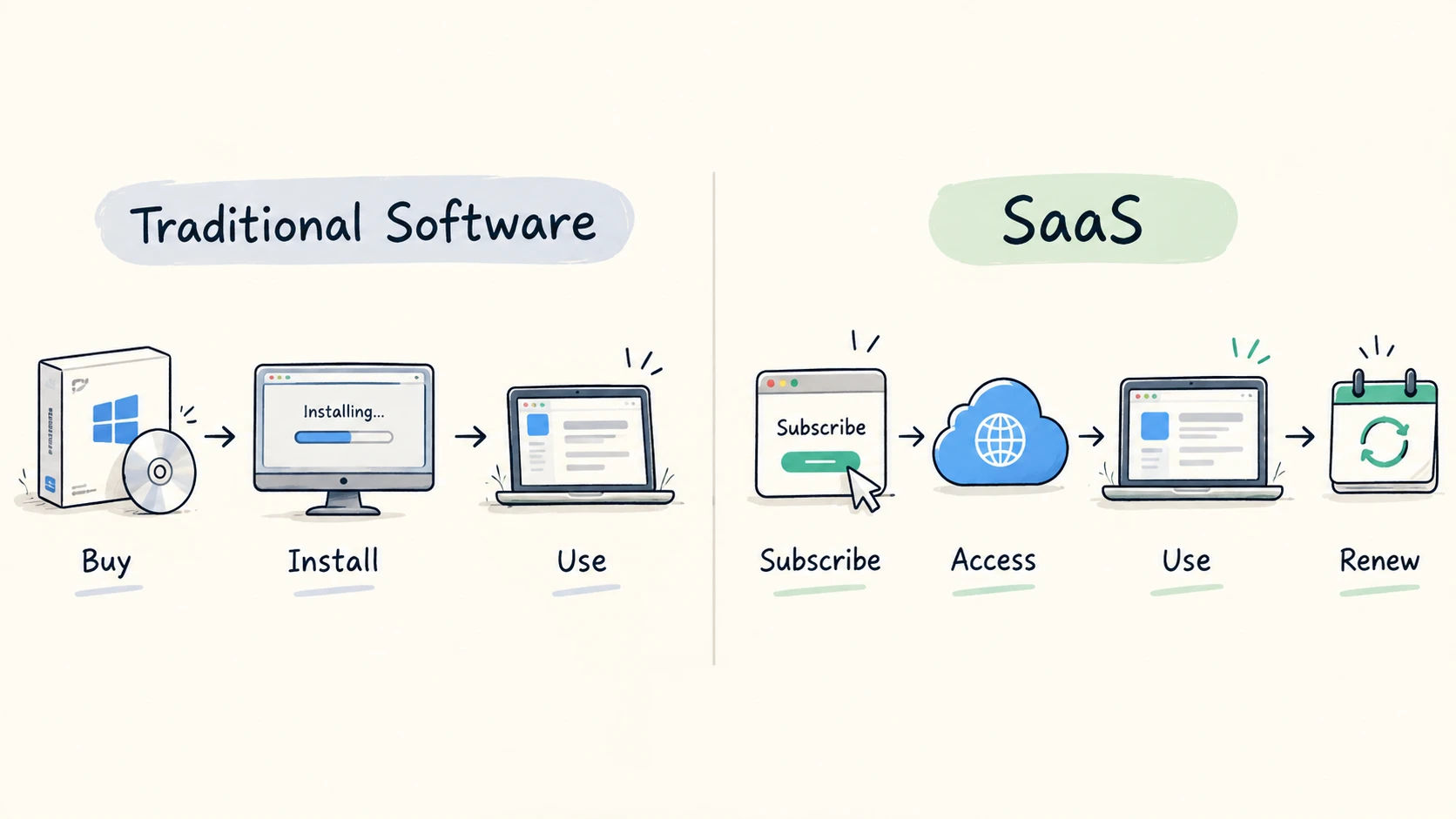
SaaS means Software as a Service: software that customers access as a service, usually over the internet, instead of buying and installing permanently.
Examples include Notion, Slack, Figma, Canva, Shopify, and GitHub.
Instead of:
Pay ₹5,000 once and own the software
SaaS commonly works like this:
Pay ₹500 per month and keep using the software
The important idea is recurring revenue.
The SaaS Business Model
Subscription
A subscription is a recurring payment that lets a customer continue using the product. Common billing periods are monthly, quarterly, and yearly.
MRR: Monthly Recurring Revenue
MRR is the predictable recurring revenue expected each month.
For example:
ARR: Annual Recurring Revenue
ARR is the annualized value of recurring revenue. A common shorthand is MRR × 12:
In practice, the exact calculation can depend on contract structure and how a business recognizes recurring revenue.
Revenue and Recurring Revenue
Revenue is all money generated by the business. It is not necessarily the same as profit.
Recurring revenue is revenue expected to repeat, such as a subscription payment.
One-time revenue is money received only once, such as ₹10,000 for an implementation project.
Expansion, Contraction, and Churned Revenue
Expansion revenue is additional revenue from existing customers. If a customer moves from ₹1,000 per month to ₹2,000 per month, the additional ₹1,000 is expansion revenue.
Contraction revenue is revenue lost when an existing customer spends less. A move from ₹2,000 per month to ₹1,000 per month creates ₹1,000 of contraction.
Churned revenue is recurring revenue lost because customers cancel.
Customer Metrics
SaaS companies distinguish between several kinds of people and organizations in the customer journey.
Lead, Prospect, Customer, Account, and User
- A lead is someone who might become a customer.
- A prospect is a lead who appears to be a realistic potential customer.
- A customer is someone who has purchased.
- An account usually means the customer organization or company.
- A user is someone who actually uses the product.
One account can contain many users:
ICP: Ideal Customer Profile
The Ideal Customer Profile describes the type of customer your product is specifically designed for.
For example:
Small Indian coaching institutes with 100–500 students.
That is more useful than saying:
Anyone who needs education software.
Persona
A persona is a representation of a specific type of user.
For example, a teacher persona might:
- be 30–45 years old;
- use a phone heavily;
- create tests and track students; and
- prefer simple software.
The ICP describes which business or customer you want. A persona describes the person using the product.
Acquisition Terms
Acquisition, Marketing, and Sales
Acquisition means getting new potential customers.
Marketing attracts attention and generates demand through channels such as SEO, content, YouTube, advertising, social media, email, and communities.
Sales turns potential customers into paying customers.
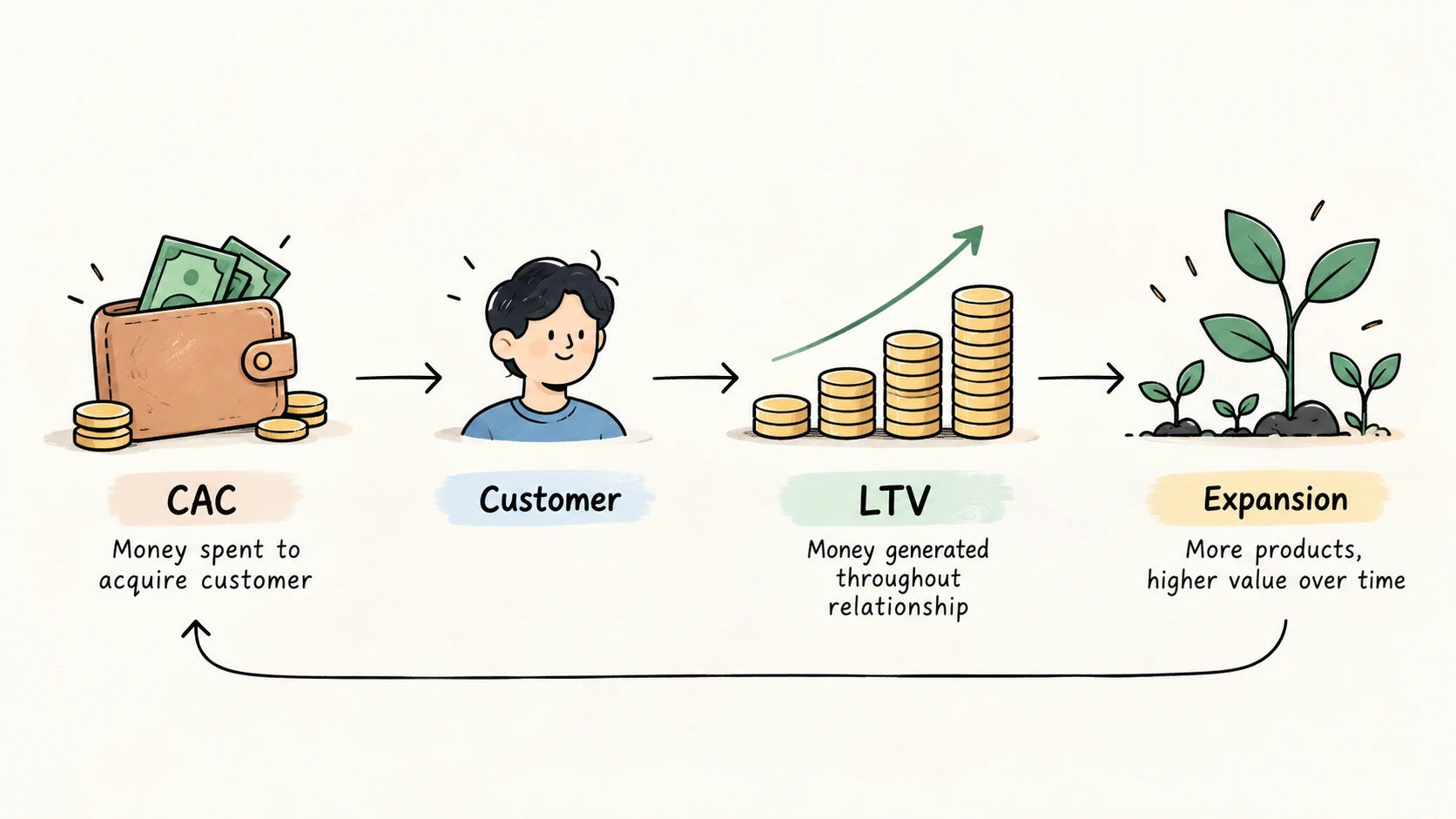
CAC: Customer Acquisition Cost
CAC is how much it costs to acquire one new customer.
If you spend ₹1,00,000 and acquire 100 customers:
CPA, CPL, CPC, and CPM
CPA, or Cost Per Acquisition, is the cost required to achieve a defined acquisition. Depending on the business, that acquisition might be a signup, lead, purchase, or customer.
CPL, or Cost Per Lead, is the cost to generate one lead. If ₹10,000 in advertising produces 100 leads, CPL is ₹100.
CPC, or Cost Per Click, is what you pay for each advertisement click.
CPM, or Cost Per Mille, is the cost per 1,000 advertisement impressions.
Organic, Paid, Referral, and Word-of-Mouth Acquisition
Organic acquisition comes from channels where you do not directly pay for each acquisition, such as search, content, community, social media, or recommendations.
Paid acquisition comes from paid channels such as Google Ads, Meta Ads, or LinkedIn Ads.
A referral happens when a customer brings another customer. Word of mouth is the broader pattern of people recommending the product to others. It is valuable because customers become part of the distribution channel.
Funnel Terms
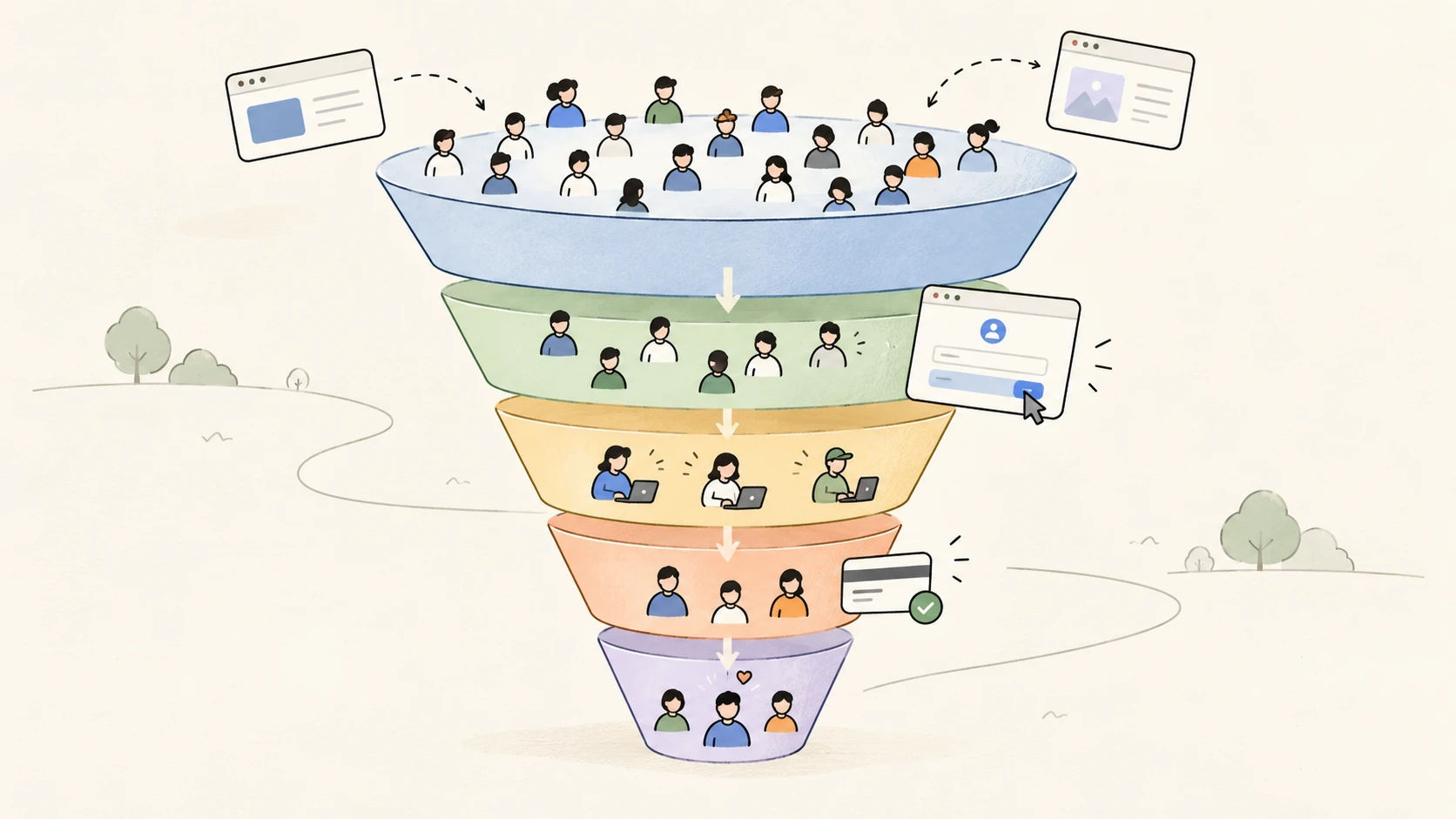
People usually move through several stages before becoming retained customers:
That sequence is the funnel.
TOFU, MOFU, and BOFU
Describes people who are discovering your product or category. They might read an article about managing an online coaching institute.
Describes people researching solutions. They may compare products, watch demos, read reviews, or explore pricing.
Describes people who are close to purchasing.
Conversion Rate
Conversion rate is the percentage of people who move from one stage to another.
For example:
Signup Rate and Activation Rate
Signup rate is the percentage of visitors who create an account.
Activation rate is the percentage of users who reach the important first-value moment.
For a project-management SaaS, activation might mean:
Create a workspace, invite a teammate, and create the first project.
Activation is not simply “the user created an account.” It is the point at which the user has experienced enough of the product to understand its value.
Aha Moment
The aha moment is when a user realizes:
“Oh, this is actually useful.”
Finding that moment matters because it often connects onboarding and activation to later retention.
Retention
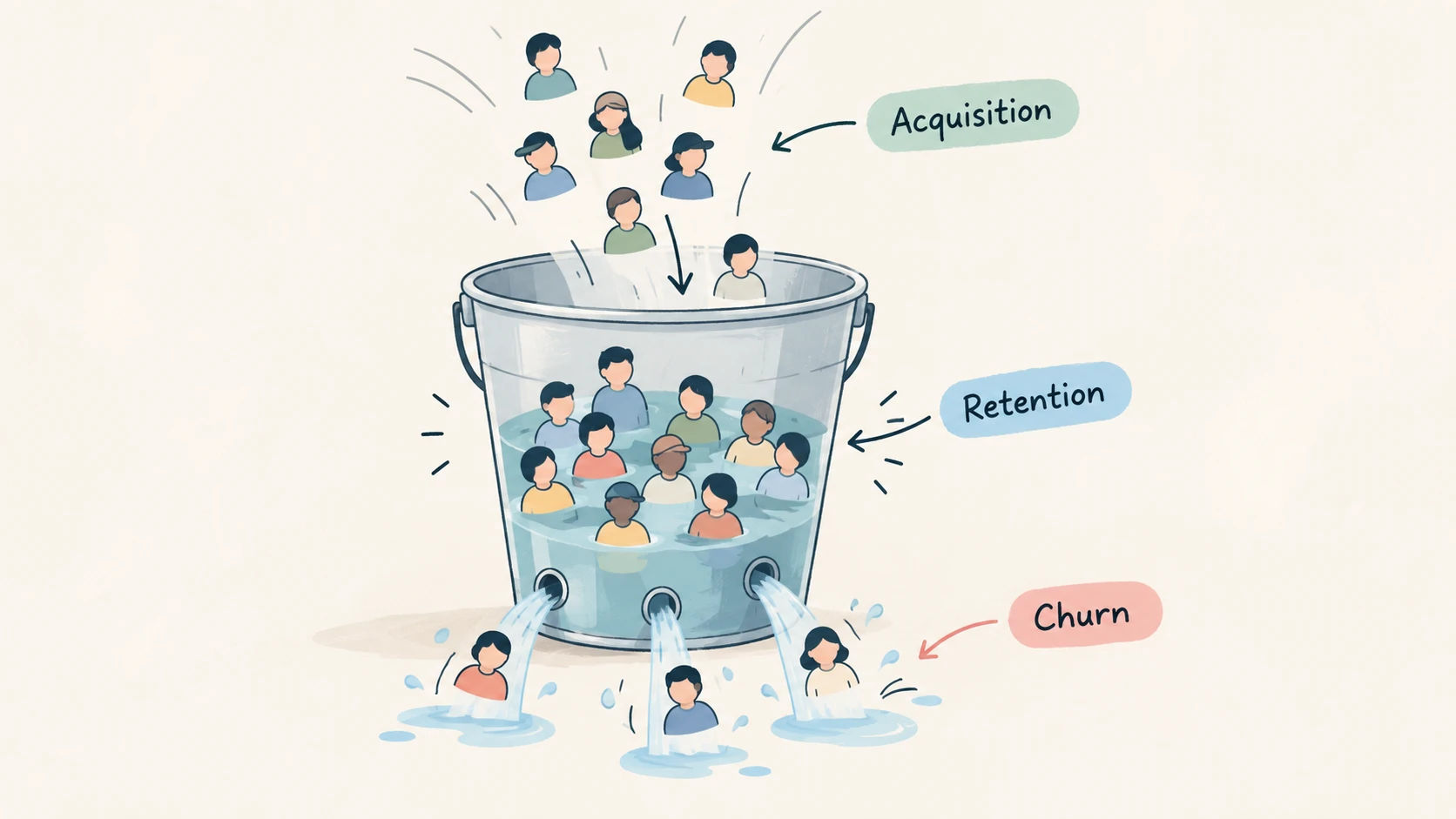
Getting customers is only half the problem. The bigger question is whether they stay.
Retention and Churn
Retention is the percentage of customers or users who continue using the product.
If 100 users start in January and 80 remain active later, retention is 80%.
Churn is the opposite: the customers or revenue that leave.
If 100 customers start a period and 5 cancel, customer churn is 5%.
Customer Churn, Revenue Churn, and Logo Churn
Customer churn rate is the percentage of customers lost during a period.
Revenue churn is the percentage of recurring revenue lost. These measures can tell different stories. Ten small customers leaving may create modest customer churn, while one very large customer leaving can create substantial revenue churn.
In B2B SaaS, a customer company is sometimes called a logo. “Five logos churned” means that five customer companies left.
Cohort Analysis
A cohort is a group of users who share something in common, such as customers who signed up in January 2026.
You can then observe what percentage of that cohort remains after one, three, six, or twelve months. This is cohort analysis.
LTV and CAC Payback
LTV: Lifetime Value
LTV is the revenue a customer is expected to generate during their relationship with the business.
The practical question is:
“If I acquire this customer today, how much might they generate before leaving?”
LTV:CAC Ratio
The LTV:CAC ratio compares customer value with acquisition cost.
If LTV is ₹30,000 and CAC is ₹5,000:
The ratio helps answer whether the business is spending too much to acquire customers.
CAC Payback Period
The CAC payback period is how long it takes to recover the money spent acquiring a customer.
If CAC is ₹6,000 and the customer generates ₹1,000 per month in contribution margin, payback takes about six months.
Pricing Terms
Free Plan, Free Trial, and Freemium
A free plan costs the customer nothing and is often used to attract users.
A free trial gives a customer access to paid features for a limited time, such as 14 days.
Freemium combines a free basic product with paid advanced features. The word is a combination of free and premium.
Premium and Tiered Pricing
The premium version is the paid version of a product.
Tiered pricing offers different packages at different prices:
Seat-Based, Usage-Based, and Hybrid Pricing
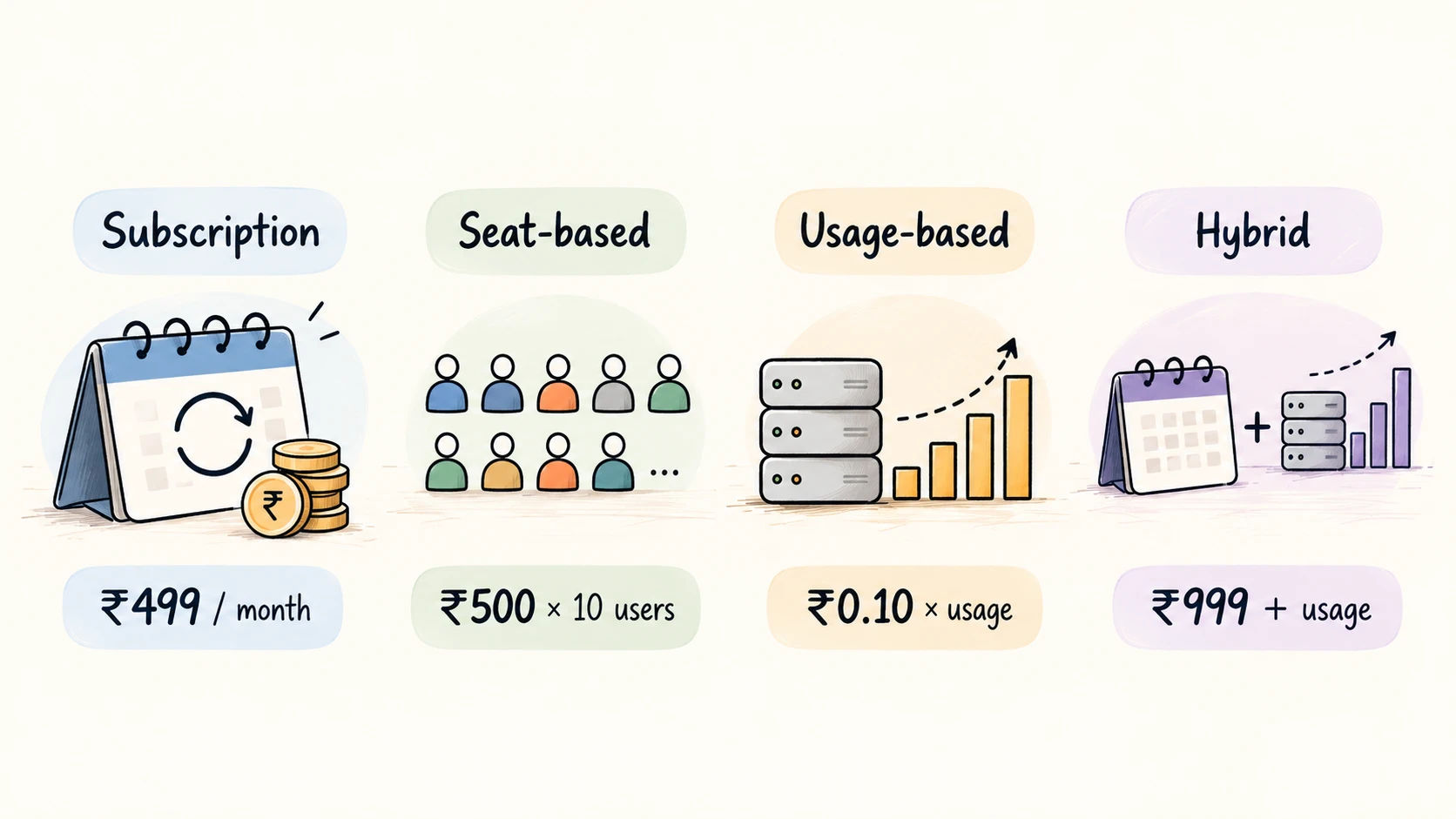
Seat-based pricing charges according to the number of users. At ₹500 per user per month, 10 users cost ₹5,000 per month.
Usage-based pricing charges according to usage, such as API requests, storage, emails sent, AI tokens, or compute.
Hybrid pricing combines a subscription with usage charges:
₹999 per month + ₹0.10 per API request
ARPU and ARPA
ARPU, or Average Revenue Per User, is the average revenue generated per user.
ARPA, or Average Revenue Per Account, is the same idea calculated per customer account rather than per individual user. It is especially useful in B2B SaaS.
Growth Metrics
MoM, YoY, and Growth Rate
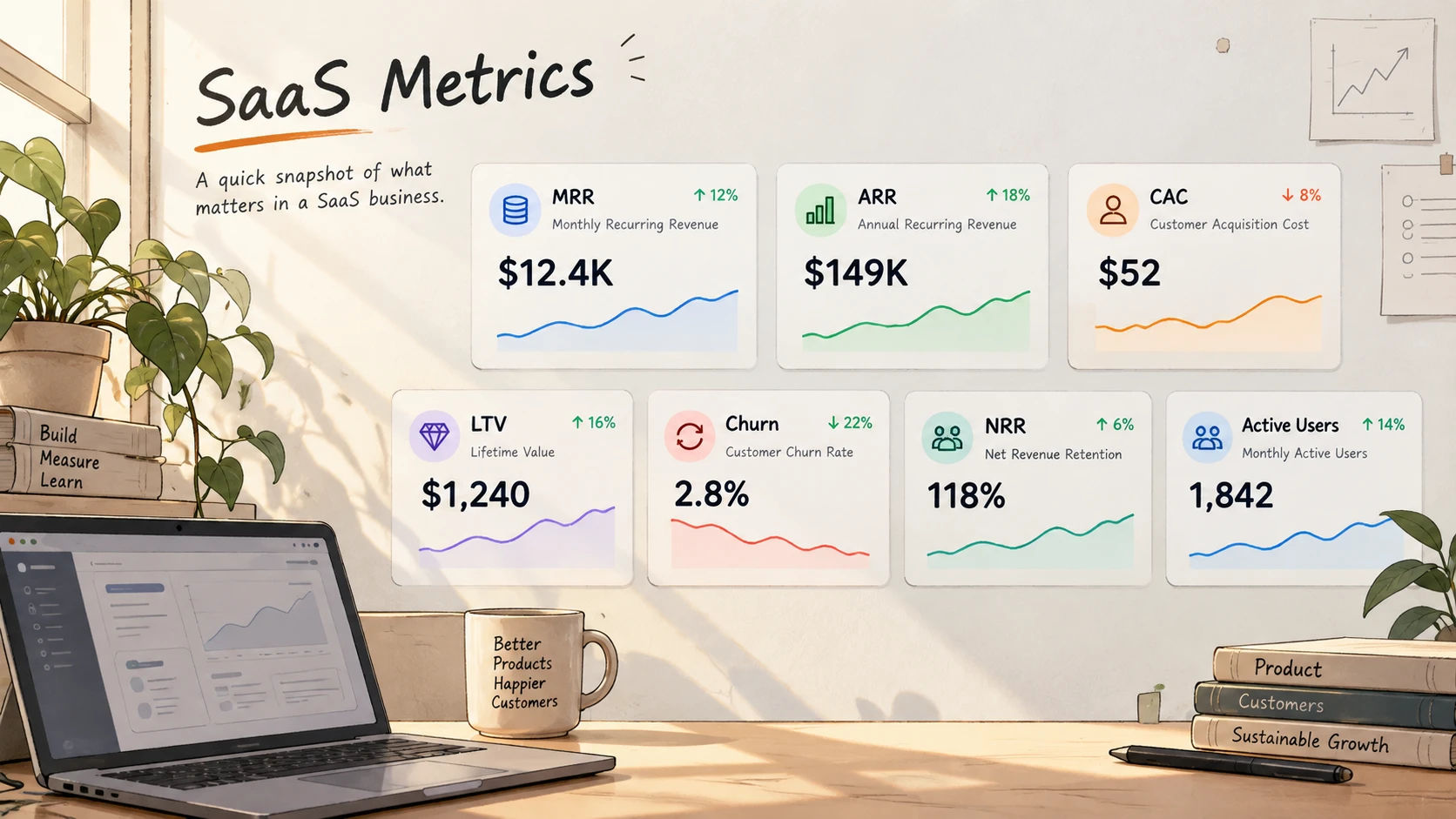
MoM, or Month over Month, compares a metric with the previous month. If MRR rises from ₹10 lakh to ₹12 lakh, MoM growth is 20%.
YoY, or Year over Year, compares a metric with the same period in the previous year.
The growth rate describes how quickly an important metric is increasing or decreasing.
NRR: Net Revenue Retention
NRR asks:
“Ignoring new customers, how much revenue did the existing customer base generate compared with before?”
It includes expansion, upgrades, contraction, and churn.
If an existing customer base starts at ₹10 lakh and reaches ₹11 lakh after expansion and churn, NRR is 110%. The existing base grew by 10% without acquiring anyone new.
GRR: Gross Revenue Retention
GRR measures how much existing recurring revenue remains without counting expansion. It answers:
“How much revenue did we retain?”
Sales Terms
B2B, B2C, and B2B2C
- B2B means Business to Business: a SaaS company sells to companies.
- B2C means Business to Consumer: a product is sold directly to individuals.
- B2B2C means Business to Business to Consumer: a business acts as the distribution path to the end consumer.
Enterprise, SMB, and Mid-Market
Enterprise describes large organizations with complex requirements, security needs, and procurement processes.
SMB means Small and Medium-sized Business.
Mid-market describes companies between SMB and enterprise.
Self-Serve and Sales-Assisted
With a self-serve product, a customer can discover, sign up, pay, and use the product without speaking to sales.
With a sales-assisted product, a salesperson helps the customer evaluate and purchase it.
A demo is a product walkthrough, usually led by a salesperson or product specialist.
PQL, SQL, and MQL
A PQL, or Product Qualified Lead, is a user whose product behavior suggests they may become a customer. A free user who invites 10 teammates, uses advanced features, and creates 20 projects may show buying intent.
An SQL, or Sales Qualified Lead, is a lead the sales team considers worth pursuing.
An MQL, or Marketing Qualified Lead, meets marketing-defined criteria that suggest potential buying interest.
The Sales Pipeline
A sales pipeline represents potential deals moving toward purchase. Typical stages are:
Pipeline and Deal
The pipeline is the collection of active potential deals.
A deal is one potential customer transaction.
ACV and TCV
ACV, or Annual Contract Value, is the annualized value of a customer contract.
TCV, or Total Contract Value, is the value of the entire contract. A three-year contract worth ₹10 lakh per year has a TCV of ₹30 lakh.
Win Rate and Sales Cycle
Win rate is the percentage of sales opportunities that become customers.
The sales cycle is the time from the initial sales engagement to closing the deal.
Closed-won means the customer purchased. Closed-lost means the customer did not purchase.
Product Terms
PMF: Product-Market Fit
Product-market fit means the product solves a problem that enough people genuinely care about.
The key question is:
“Do people want this badly enough to keep using and paying for it?”
PMF is not simply that people like the product. It is closer to the market consistently pulling the product out of the company.
MVP: Minimum Viable Product
An MVP is the smallest version of a product that can test whether the core idea works.
It does not mean “build something terrible.” It means:
Build the minimum necessary thing to learn something important.
Value Proposition and USP
A value proposition explains why someone should choose your product.
Create professional websites without writing code.
A USP, or Unique Selling Proposition, is a specific characteristic that differentiates the product.
Feature, Benefit, and Use Case
A feature is something the product can do, such as exporting reports as PDF.
A benefit is the outcome the customer receives, such as saving two hours every week through automated reports.
Customers generally buy outcomes, not feature lists.
A use case is a specific situation in which the product is useful.
A pain point is a problem or frustration experienced by the customer.
JTBD: Jobs To Be Done
Jobs To Be Done changes the question from:
“What product does the customer want?”
to:
“What job is the customer trying to accomplish?”
For example, a customer may not really want project-management software. They may want to know what everyone is working on without constantly asking.
Business Economics
Gross Margin, COGS, and Gross Profit
Gross margin is the proportion of revenue left after subtracting the direct cost of delivering the product or service.
COGS, or Cost of Goods Sold, includes direct delivery costs. For SaaS, this may include:
- cloud infrastructure;
- hosting;
- payment processing;
- customer support in some accounting setups; and
- third-party services required to deliver the product.
Gross profit is revenue minus COGS.
SaaS products often have relatively high gross margins because serving additional customers does not require proportional physical production. That does not mean every SaaS business has high margins; infrastructure, support, and third-party costs still matter.
Burn Rate and Runway
Burn rate is how quickly a company spends cash.
If a company has ₹50 lakh in cash and spends ₹5 lakh more than it generates each month, its burn rate is ₹5 lakh per month.
Runway is how long the company can continue before running out of cash at its current burn rate:
Profit and EBITDA
Profit is revenue minus expenses.
EBITDA means Earnings Before Interest, Taxes, Depreciation, and Amortization. It is a financial measure often used to discuss operating performance.
Startup Funding Terms
Bootstrapped, VC, and Angel Investor
A bootstrapped company is funded primarily by its founders and business revenue rather than external investors.
VC, or Venture Capital, refers to investment firms that invest in startups they expect could grow significantly.
An angel investor is an individual who invests their own money in startups.
Seed Round and Series A
A seed round is early startup funding.
Series A is a later funding stage typically used to build and scale the business after early validation. You may then hear Series B, Series C, and so on.
These are not rigid universal stages. Companies can raise different kinds of rounds depending on their circumstances.
Valuation, Equity, Dilution, and Cap Table
Valuation is the estimated value of a company in an investment transaction or another context.
Equity is ownership in a company.
Dilution happens when new shares are issued and an existing owner's percentage decreases. If you own 100% initially and an investor receives 20%, your ownership becomes 80%.
A cap table, short for capitalization table, records who owns what percentage of the company.
SaaS Growth Concepts
PLG, SLG, and MLG
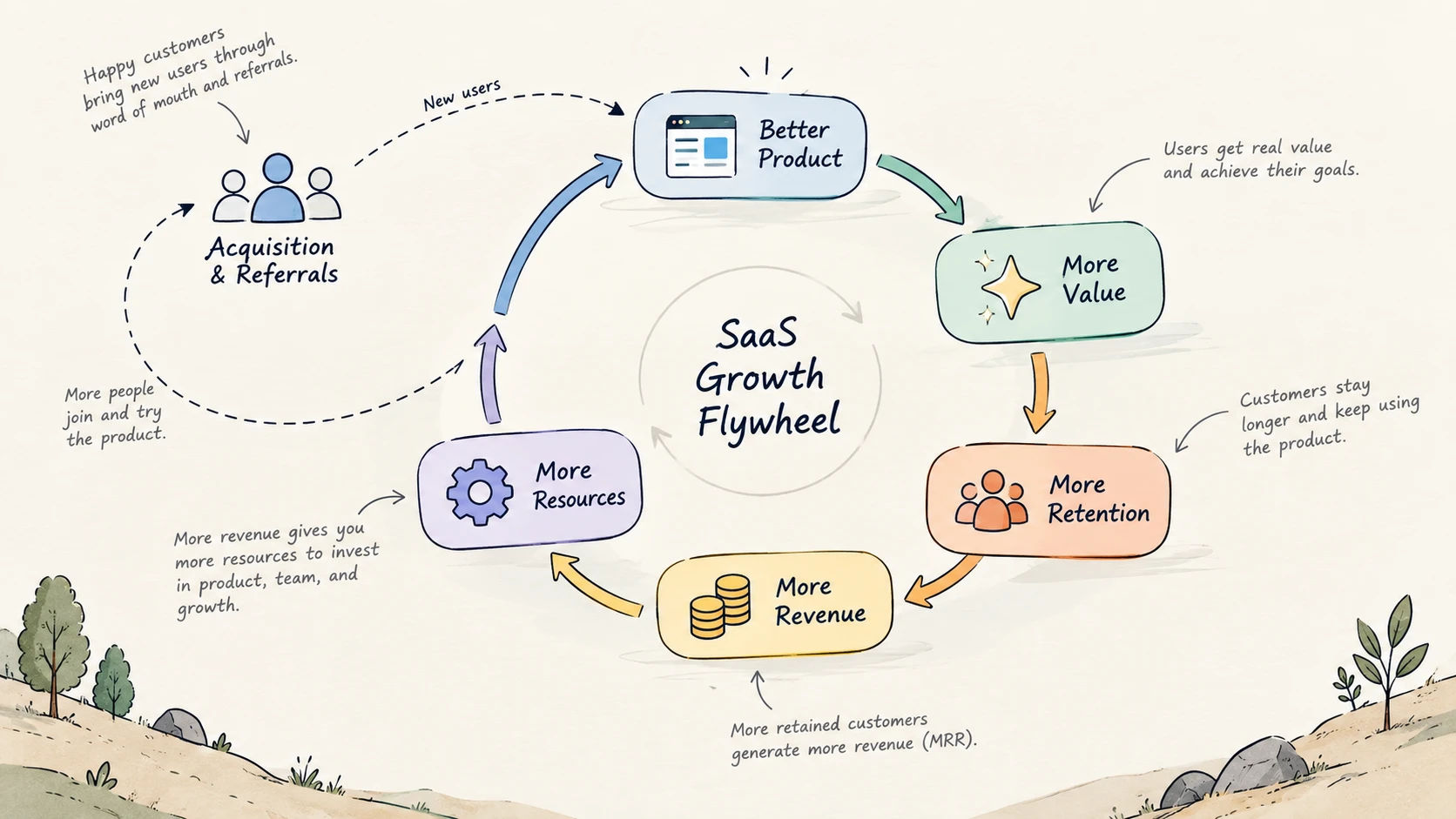
PLG, or Product-Led Growth, means the product itself drives acquisition, activation, conversion, and expansion.
SLG, or Sales-Led Growth, means salespeople are the primary growth engine. This is common in enterprise SaaS.
MLG, or Marketing-Led Growth, means marketing is the primary driver of customer acquisition and demand generation.
Land and Expand
Land and expand means starting with a small customer relationship and expanding within the organization.
For example, a product might begin with five employees and eventually reach 500.
Cross-Sell, Upsell, and Downsell
Cross-sell means selling another product or service to an existing customer.
Upsell means moving an existing customer to a more expensive plan.
Downsell means moving a customer to a cheaper plan rather than losing them completely.
Customer Success
Customer Success and Customer Support
Customer Success, often abbreviated as CS, is the team responsible for helping customers achieve value from the product.
Support asks:
“What's broken?”
Customer Success asks:
“Are you getting the outcome you wanted?”
Customer Support helps customers solve problems.
Onboarding and TTV
Onboarding is the process of helping a new customer start successfully.
TTV, or Time to Value, is how long it takes for a customer to experience meaningful value. A shorter TTV is often desirable because customers who never experience value have little reason to stay.
Health Score
A health score is a signal representing how healthy a customer relationship appears to be. It might consider:
- product usage;
- support tickets;
- login frequency;
- feature adoption; and
- payment behavior.
Product Usage Terms
DAU, WAU, and MAU
- DAU means Daily Active Users.
- WAU means Weekly Active Users.
- MAU means Monthly Active Users.
DAU/MAU, Feature Adoption, and Engagement
DAU/MAU is a rough measure of how frequently monthly users return. If DAU is 2,000 and MAU is 10,000, DAU/MAU is 20%.
Feature adoption is the percentage of users who use a particular feature.
Engagement describes how deeply users interact with the product.
Stickiness describes how often users return and continue using the product.
Experimentation
A/B Test, Control Group, and Variant
An A/B test shows two versions to different groups and compares the results.
For example:
- A: “Start Free Trial”
- B: “Try It Free”
The control group receives the existing experience. The variant receives the new version being tested.
Hypothesis and Conversion Event
A hypothesis is a prediction about what might happen:
Reducing signup fields from eight to three will increase signup completion.
A conversion event is the action being measured, such as signup, purchase, upgrade, or activation.
Statistical Significance
Statistical significance helps assess whether an observed difference is unlikely to be explained by random variation alone. It does not, by itself, prove that a change is practically important or that the result will generalize forever.
SaaS Strategy Terms
TAM, SAM, and SOM
The theoretical total market opportunity — everyone who could theoretically need and buy the product or service.
The segment of TAM your business can realistically serve based on your offering, geography, and business model.
The portion of SAM you can realistically capture in the near term with your current resources and distribution.
Competitive Advantage and Moat
A competitive advantage makes it difficult for competitors to take your customers or replicate your position.
A moat is a durable advantage that protects a business over time. Examples include network effects, a strong brand, distribution, proprietary data, switching costs, and economies of scale.
Switching Cost and Network Effect
Switching cost is how difficult or expensive it is for a customer to move from your product to another.
A network effect occurs when a product becomes more valuable as more people use it. A communication platform becomes more useful when the people you want to communicate with are already there.
Quick Reference
The Mental Model Behind the Vocabulary
You do not need to memorize every SaaS term. Most businesses can be understood through one loop:
- Find people with a problem.
- Help them discover your product.
- Get them to try it.
- Help them experience value.
- Convert them into paying customers.
- Keep them.
- Get them to spend more over time.
- Acquire more customers efficiently.
- Make more money than it costs to operate and grow.
Almost every SaaS metric describes one part of this loop:
- CAC asks how expensive it is to acquire a customer.
- Activation asks whether the user experienced value.
- Conversion asks whether the user paid.
- Churn asks whether the customer left.
- Retention asks whether the customer stayed.
- LTV asks how valuable the customer is.
- MRR asks how much recurring revenue the business generates.
- NRR asks whether existing customers are becoming more or less valuable.
- Burn asks how quickly the company is consuming cash.
- Runway asks how long the company can keep going.
- PMF asks whether the market genuinely wants what the company is building.
Once you understand the business model underneath the words, the acronyms stop feeling like jargon. They become measurements of what is actually happening inside a company.